
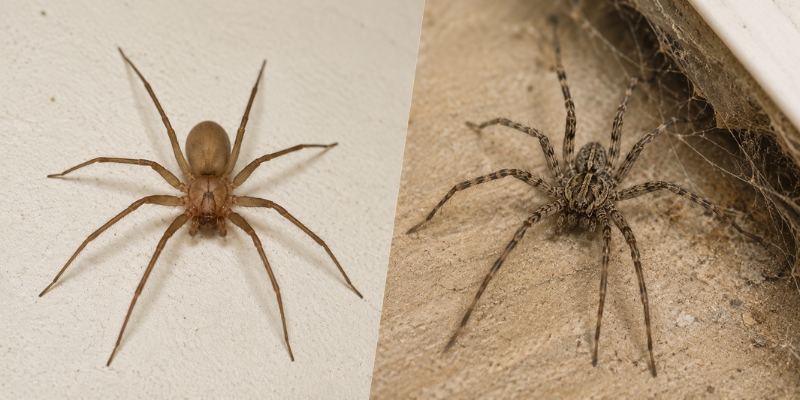
A brown spider on a wall can be difficult to identify while it is moving, and several common Nashville species are regularly mistaken for brown recluses. Color, body size, and a vague dark mark provide too little information on their own. Start with the spider's shape, eyes, legs, web, and hiding location, then seek a reliable identification if uncertainty remains. All Pest Solutions offers spider control in Nashville when repeated sightings or a potentially significant species call for a closer inspection.
Begin With the Whole Spider, Not One Marking
The violin-shaped mark associated with a brown recluse receives most of the attention. Other spiders can have dark patterns that resemble a violin when viewed quickly. Dust, shadows, damage to the specimen, and phone-camera blur can create misleading shapes as well.
Brown recluse identification depends on a combination of features. Adults generally have a plain tan or brown body, a darker mark on the cephalothorax, and legs that appear fairly uniform rather than strongly banded or heavily spined. They have six eyes arranged as three pairs. Confirming the eye pattern usually requires magnification and a motionless specimen, which makes it an impractical first test for a live spider on the wall.
Many spiders called “house spiders” have mottled abdomens, visible leg bands, prominent hair or spines, or eight eyes in patterns that differ from a recluse. Those details can help rule out a brown recluse, although species-level identification may still require expertise.
Compare Behavior and Location
Where the spider was found adds context. Brown recluses favor dry, sheltered, seldom-disturbed spaces. A spider discovered inside an old box, behind stored items, in a quiet closet, or along an attic edge fits their general behavior better than one sitting in the center of a large outdoor web.
Common house spiders often build tangled webs in upper corners, around window frames, or behind furniture. Cellar spiders rest in loose webs and have extremely long, thin legs. Funnel weavers create sheetlike webs with a retreat. Orb weavers construct the familiar wheel-shaped webs found outdoors near porches, landscaping, and lights.
Wolf spiders are another frequent source of confusion. They are active hunters and may run across floors without using a prey-catching web. Most have patterned bodies, sturdier legs, and a hairier appearance than a brown recluse. Their speed and size make them alarming, but those traits do not turn them into recluses.
Use a Simple Identification Checklist
Observe from a safe distance and record what you can:
- Is the body plain tan or brown, or does it have obvious stripes and mottling?
- Are the legs uniform, or are they banded, thick, very hairy, or visibly spined?
- Is the spider in an irregular retreat, a structured web, or no web at all?
- Was it found in protected storage or in an open, high-traffic area?
- Can a clear photograph show the body from above without requiring close handling?
- Have similar spiders appeared repeatedly in the same part of the home?
These observations narrow the possibilities. They cannot always provide a final identification, especially from a single low-quality photo.
Capture Evidence Without Handling the Spider
A clear image is useful when the spider stays still long enough to photograph safely. Include an object nearby for scale only if it can be placed without approaching or disturbing the spider. Avoid reaching into a web, corner, box, or dark space with bare hands.
Glue boards placed flat along walls can collect wandering spiders and show where activity is concentrated. Position them where children and pets cannot reach them, and follow the product directions. Inspecting several boards over time provides a better activity pattern than one trap in the room where a spider happened to appear.
If a spider is safely contained, keep the specimen intact for identification. Crushing it can destroy the eye arrangement and body markings an inspector needs to see.
Take Sensible Precautions in Storage Areas
Suspected brown recluse activity calls for care around stored clothing, shoes, linens, boxes, and seasonal decorations. Wear gloves when moving long-neglected items. Shake out footwear and clothing before use. Keep belongings off the floor when possible and replace deteriorating cardboard with sealed plastic containers.
Vacuuming along edges and removing clutter makes inspections easier. It also removes webs, egg sacs, and some insects that serve as prey. Cleaning can reduce favorable conditions, while gaps, wall voids, hidden storage, and prey activity may still need attention.
Let the Identification Guide the Plan
Treatment for an established indoor brown recluse population requires a different plan than removal of a few outdoor web-building spiders. A professional inspection can evaluate likely species, monitoring evidence, hiding areas, entry points, and the insects supporting spider activity. That information prevents a broad response based only on fear or a single body color.
If you are unsure whether you found a brown recluse or another house spider, save a photo or safely contained specimen and let All Pest Solutions examine the evidence. Contact the All Pest Solutions team to schedule an inspection for your Nashville home and discuss the appropriate next step.